How Positive Charge Membrane Technology Redefines Countertop Water Purification
Jul 31, 2026The Evolution of Water Purification Beyond Pore Size
For decades, membrane filtration technologies have been developed around one fundamental principle: physical separation based on pore size.
From microfiltration (MF) and ultrafiltration (UF) to reverse osmosis (RO), membrane technology has continuously improved by reducing pore sizes and increasing filtration precision. This approach has enabled effective removal of many traditional water contaminants, including suspended particles, microorganisms, and dissolved substances.
However, the challenges facing modern drinking water quality are becoming increasingly complex.
Today, water purification is no longer only focused on visible particles or conventional contaminants such as chlorine. Growing attention is being placed on emerging contaminants including PFAS, pharmaceutical residues, heavy metals, microorganisms, and other trace pollutants. These new challenges require filtration technologies that can achieve more than simple physical screening. A modern purification system needs to balance multiple factors: contaminant reduction performance, energy efficiency, system simplicity, and user convenience.
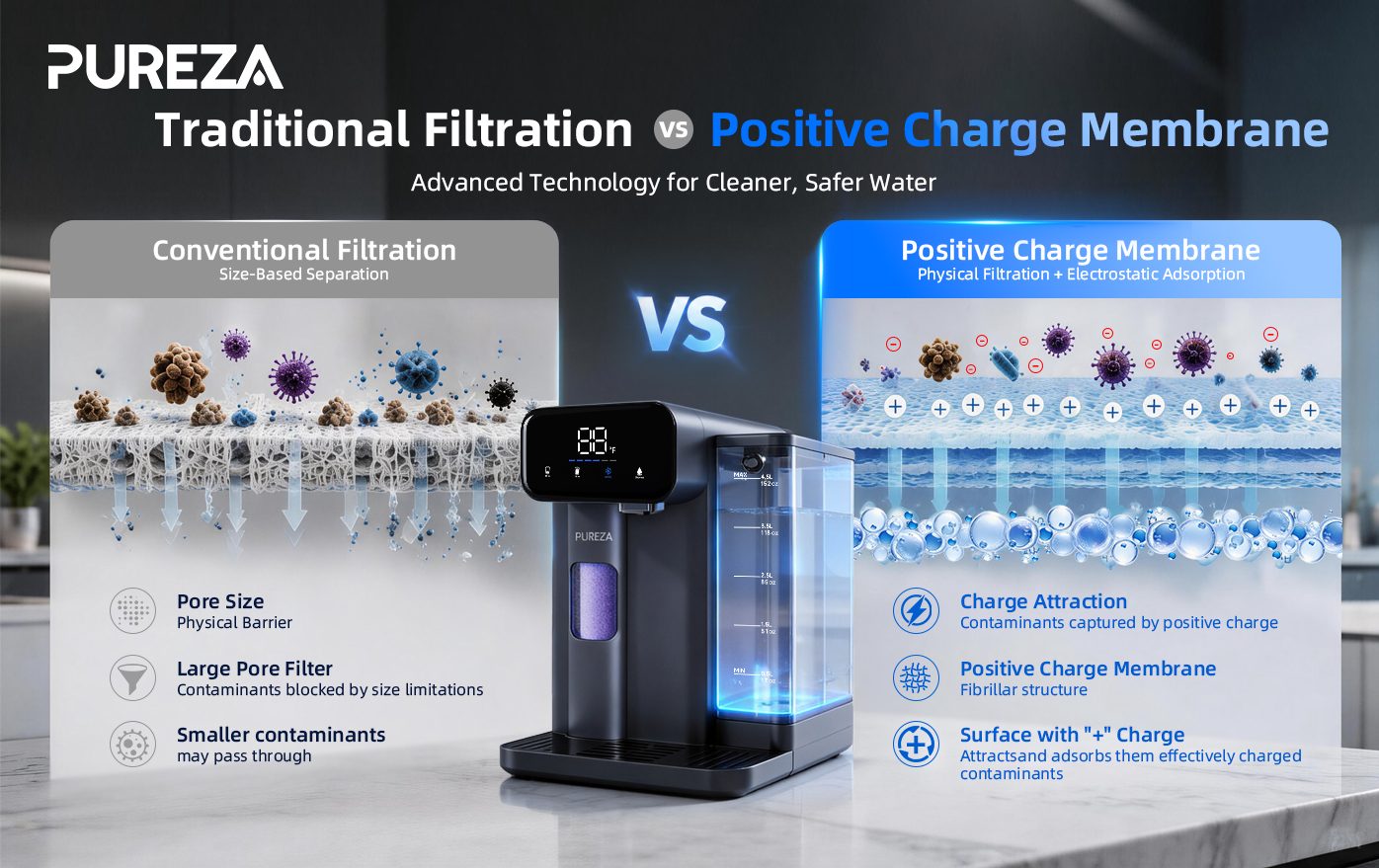
Positive Charge Membrane technology represents a different approach to membrane filtration. Instead of relying solely on smaller pore sizes, it combines physical filtration with electrostatic adsorption, creating a more comprehensive contaminant capture mechanism. By introducing this advanced membrane technology into countertop cold water purification systems, Pureza PU-T02 countertop cold water dispenser demonstrates a new direction for efficient and practical household water purification.
The Challenge of Traditional Filtration Technologies
Understanding the Limits of Size-Based Filtration
Traditional membrane filtration technologies have played an important role in water treatment for decades. However, each filtration method has its own advantages and limitations depending on the application.
Ultrafiltration (UF) membranes mainly work through physical size exclusion. With typical pore sizes ranging from approximately 0.01 to 0.1 microns, UF technology is effective at reducing suspended particles, colloids, and many bacteria. However, because UF relies primarily on physical separation, its ability to remove dissolved contaminants is limited.
Many emerging contaminants, including PFAS, heavy metals, pharmaceutical residues, and certain organic compounds, are much smaller than membrane pores or exist in dissolved forms, making them difficult to remove through conventional size-based filtration alone. Virus removal performance can also vary depending on membrane structure and operating conditions, creating additional challenges for applications requiring higher levels of microbial protection.
On the other hand, reverse osmosis (RO) provides excellent purification performance by using pressure-driven separation through a semi-permeable membrane. RO technology is widely recognized for its ability to reduce dissolved salts, TDS, and many chemical contaminants. However, traditional RO systems also require higher system complexity, including high-pressure pumps and additional components. In household applications, RO systems may also generate wastewater and remove naturally occurring minerals during the purification process.
Therefore, while RO remains an effective solution for specific applications such as desalination and high TDS reduction, there is increasing demand for filtration technologies that provide strong contaminant control while maintaining efficiency and simplicity. This creates an important opportunity for a new generation of filtration technology between traditional UF and RO solutions.
Beyond Pore Size: The Science Behind Positive Charge Membrane Technology
A Different Filtration Mechanism Based on Electrostatic Capture
Traditional membrane filtration can be compared to a physical sieve. The membrane blocks contaminants mainly based on whether their size exceeds the pore structure. Positive Charge Membrane technology introduces a different concept.
Instead of depending only on pore size reduction, this technology uses a combination of advanced fiber structure and electrostatic adsorption to capture contaminants.
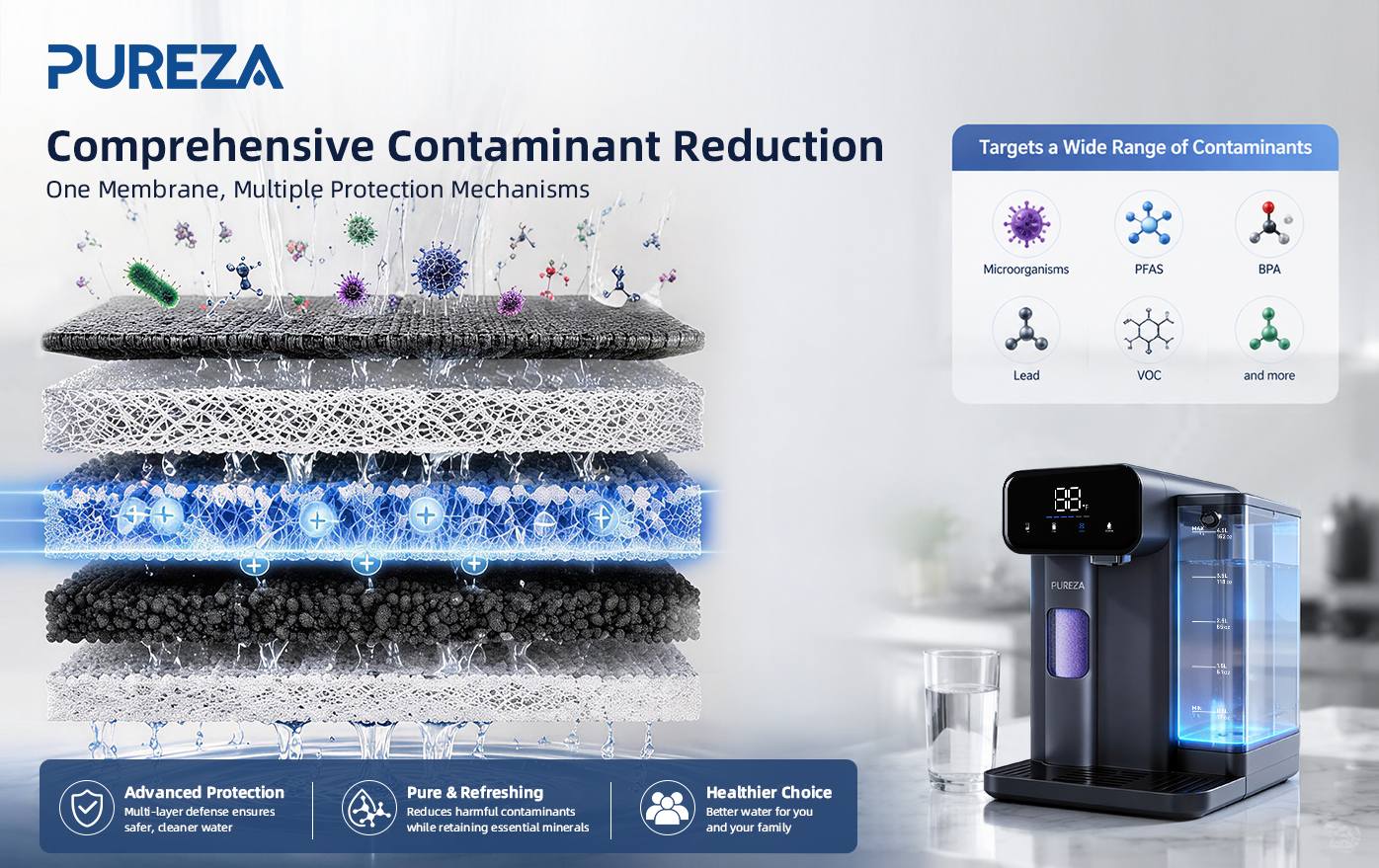
The membrane is manufactured using nano-scale natural mineral fibers with a high specific surface area. Through specialized processing technology, these fibers form a multi-layer structure that provides numerous adsorption sites throughout the filtration media. The key feature of this technology is the introduction of positively charged aluminum ions (Al³⁺) onto the membrane surface.
Many contaminants found in water, including microorganisms, heavy metal ions, and certain organic pollutants, naturally carry negative charges. When these negatively charged contaminants pass through the membrane, they are attracted and captured by the positively charged surface through electrostatic interaction. This mechanism allows the membrane to achieve high contaminant reduction performance without relying solely on extremely small pore sizes.
Unlike conventional filtration concepts that focus only on “how small the pores are,” Positive Charge Membrane technology focuses on “how effectively contaminants can be captured.” This represents a shift from passive filtration toward a more active contaminant capture mechanism.
Comprehensive Contaminant Reduction Through Combined Filtration Mechanisms
Beyond Particle Removal: Addressing Biological and Chemical Contaminants
One of the key advantages of Positive Charge Membrane technology is its ability to address a wider range of contaminants by combining multiple filtration mechanisms.
Unlike conventional filtration technologies that mainly focus on a single category of contaminants, Positive Charge Membrane technology provides a more comprehensive approach by combining physical interception, electrostatic adsorption, and, when integrated with activated carbon, adsorption of organic compounds.
This multi-functional filtration mechanism enables the membrane to effectively target both biological and chemical contaminants commonly found in drinking water.
For microbial contaminants, Positive Charge Membrane technology demonstrates strong reduction performance.
According to testing data, the membrane achieves:
≥99.9999% bacteria reduction;
≥99.99% virus reduction;
≥99.99% cyst reduction.
The technology has demonstrated effectiveness against representative microorganisms, including E. coli, MS2 bacteriophage, Cryptosporidium, and Giardia.
This performance is particularly important for household water filtration systems, where users increasingly expect not only improved taste and clarity, but also reliable protection against microbial contamination.
Beyond microorganisms, the membrane technology also provides capabilities for reducing various chemical contaminants.
When combined with activated carbon, the Positive Charge Membrane structure creates a complementary filtration system. The activated carbon component contributes adsorption capacity for organic compounds, while the positively charged membrane surface enhances the capture of negatively charged contaminants.
This combined mechanism enables reduction of contaminants such as chlorine, PFAS compounds including PFOA and PFOS, VOCs, BPA, PCB, and pharmaceutical residues.
The technology also demonstrates reduction capability for several heavy metals, including lead (Pb), chromium (Cr⁶⁺), copper (Cu), and iron (Fe).
Through this combination of physical filtration and electrostatic adsorption, Positive Charge Membrane technology provides a broader protection range compared with filtration systems that rely on a single removal mechanism.
Why Positive Charge Membrane Technology Fits the Future of Countertop Water Purifiers
Balancing Performance, Efficiency, and User Convenience
Countertop water purifiers have unique requirements compared with traditional under-sink or whole-house filtration systems.
Because these systems are designed for direct consumer use, filtration technology must achieve a balance between purification performance, compact design, energy efficiency, and ease of maintenance.
Positive Charge Membrane technology provides several characteristics that make it suitable for countertop applications.
First, the technology operates without the high-pressure requirements typically associated with reverse osmosis systems.
Traditional RO systems require pressure-driven separation, which means additional components such as high-pressure pumps are necessary. Positive Charge Membrane technology, by contrast, utilizes electrostatic adsorption mechanisms and can operate under lower-pressure conditions.
This helps simplify system design and improves suitability for compact countertop products.
Second, the technology supports zero wastewater operation.
Unlike RO systems that separate concentrated contaminants into wastewater streams, Positive Charge Membrane filtration does not require wastewater discharge during normal operation.
This characteristic is particularly valuable for household countertop water dispensers, where consumers increasingly consider water efficiency and environmental impact.
Third, the filtration mechanism differs from desalination-based purification.
While RO reduces dissolved minerals as part of the purification process, Positive Charge Membrane technology focuses on contaminant capture through physical filtration and electrostatic interaction, allowing naturally occurring minerals to remain in the water.
For everyday drinking water applications, this provides a more balanced purification approach.
PU-T02 Countertop Cold Water Dispenser: Applying Advanced Membrane Technology to Everyday Chilled Water Experience
A New Generation of Countertop Cold Water Purification
The development of advanced filtration technology is ultimately about solving real-world drinking water challenges.
By integrating Positive Charge Membrane technology into the Pureza PU-T02 countertop water dispenser, Pureza combines advanced purification performance with the convenience of chilled drinking water.
Unlike traditional water filtration systems that may require complex installation or produce wastewater, PU-T02 is designed around a simpler user experience.
The system combines:
- Advanced contaminant reduction through Positive Charge Membrane technology;
- Zero wastewater filtration design;
- Countertop-friendly integration;
- Convenient filter replacement;
- Chilled water dispensing capability.
With its filtration technology and cooling function, PU-T02 provides a practical solution for households and commercial environments seeking safer, cleaner, and more convenient drinking water.
The value of PU-T02 is not only in providing filtered water, but in integrating advanced filtration science into an everyday appliance.
By combining high-performance membrane technology with a compact countertop design, PU-T02 represents a new approach to modern water purification — one that focuses on efficiency, convenience, and reliable drinking water quality.
Moving Beyond Smaller Pores Toward Smarter Filtration
The future of water purification is not simply defined by smaller membrane pores.
While pore size remains an important factor in filtration performance, modern water challenges require technologies that can address different types of contaminants through more intelligent mechanisms.
Positive Charge Membrane technology demonstrates how advanced material science can expand the possibilities of membrane filtration.
By combining physical filtration with electrostatic adsorption, it provides an effective approach for reducing microorganisms, chemical contaminants, and heavy metals while maintaining system efficiency and convenience.
For countertop water purification, this technology represents an important step toward more balanced solutions — delivering advanced filtration performance without unnecessary complexity.
Through PU-T02, Pureza brings this next-generation filtration concept into everyday drinking water applications, providing users with a smarter way to experience purified chilled water.